IT Was Fine Until It Wasn’t—and Then Everything Stopped
“It’s been working fine.”
Most business owners say that when technology comes up. And honestly, they are not wrong until the day they are.
Systems rarely fail all at once. Instead, they drift. Small gaps form. Processes loosen. Security weakens. However, because nothing has fully broken, everything feels stable.
Then one day, it is not.
The systems freeze. Files are inaccessible. The team cannot work. Meanwhile, customers are waiting, and no one has clear answers.
That is when “fine” becomes expensive.
The Slow Build No One Sees Coming
Most failures are not sudden. They are built over time.
Updates get delayed because they interrupt the day. Backups are assumed to be working but rarely tested. Security tools are installed, but no one actively reviews them.
At the same time, new applications are added. Employees adopt tools on their own. Access permissions grow without structure.
Individually, these issues seem manageable. However, together, they create real exposure.
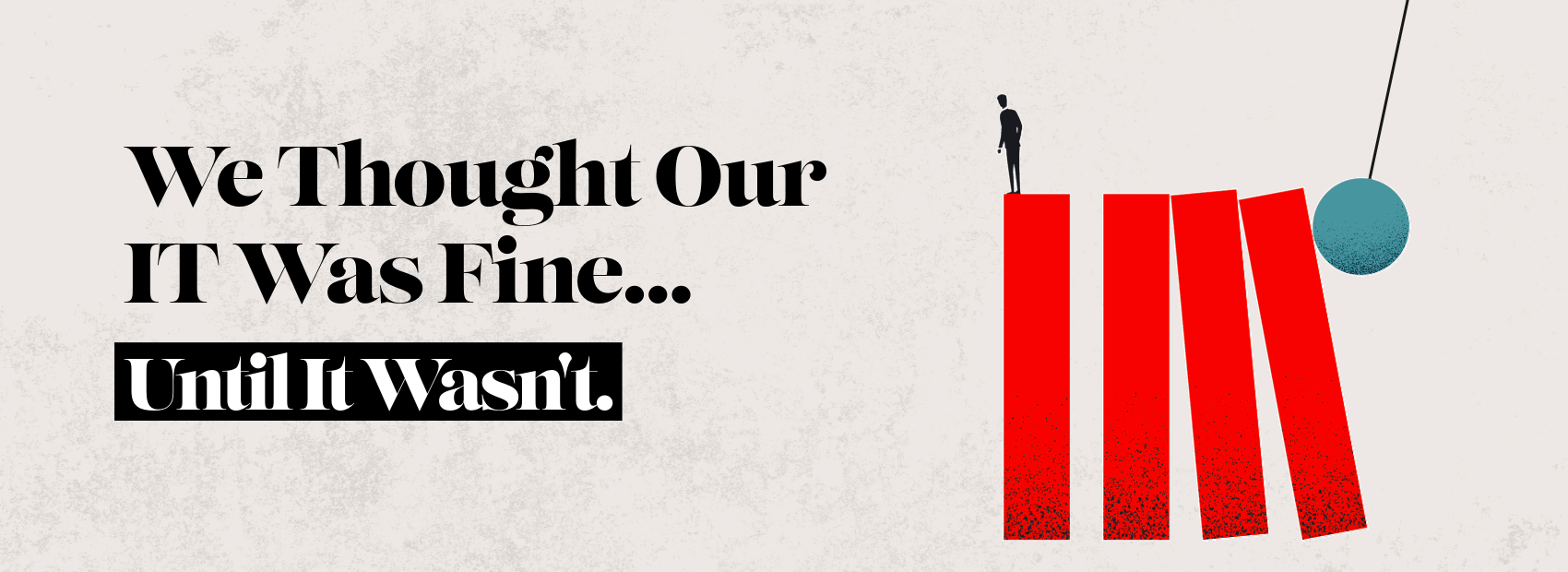
This is exactly how IT was fine until it wasn’t.
The Moment Everything Changes
There is always a moment when the business realizes something is wrong.
Sometimes, it is ransomware locking files. Other times, it is a failed server or corrupted data. In many cases, nothing works, and no one knows why.
At that point, the questions come fast:
- How quickly can we recover?
- What data is lost?
- Who is responsible?
- How much will this cost?
Unfortunately, these questions are being asked too late.
The Hidden Cost of “Fine”
Downtime is not just an inconvenience. It affects revenue, productivity, and trust.
According to the IBM Cost of a Data Breach Report, the financial impact of incidents continues to rise, even for smaller organizations.
At the same time, guidance from the Cybersecurity and Infrastructure Security Agency highlights that many attacks succeed due to basic gaps, such as weak access controls and untested recovery plans.
The real issue is not just the event. It is the lack of preparation behind it.
When businesses assume everything is fine, they often miss:
- Gaps in backup and recovery
- Weak security configurations
- Lack of documented processes
- No defined response plan
As a result, recovery takes longer and costs more.
Why Most SMBs Fall into This Trap
This pattern is common in growing businesses.
Owners are focused on operations, sales, and people. Technology is expected to just work. As a result, reviews get pushed aside.
Many businesses rely on a single internal resource or a mix of vendors. While that can work for a time, it rarely scales well.
Frameworks from the National Institute of Standards and Technology emphasize continuous assessment, monitoring, and improvement. However, most SMBs do not have the time or structure to follow that approach consistently.
So, “fine” becomes the default answer.
What “Actually Fine” Looks Like
There is a difference between nothing breaking and something being well managed.
A stable IT environment is not quite by accident. It is structured.
That includes:
- Backups that are tested regularly
- Security that is monitored continuously
- Systems that are updated on a defined schedule
- Access controls that are reviewed and maintained
Most importantly, there is a plan.
A plan for failure. A plan for recovery. A plan for growth.
The Shift from Reactive to Prepared
The businesses that avoid major disruption are not lucky. They are intentional.
They take time to understand where they stand. They identify risks early. They align technology with business outcomes.
This does not require a massive overhaul. However, it does require visibility.
It starts with simple questions:
- What happens if systems go down today?
- How fast can we recover?
- Who owns each step?
These questions expose gaps quickly.
It Doesn’t Break First
This is not about fear. It is about clarity.
Most businesses do not realize where they stand until something forces the issue. However, it does not have to happen that way.
With the right visibility and planning, “fine” can mean stable, secure, and scalable.
Take the First Step Toward Confidence
If your environment feels fine, that is a good starting point. However, it is worth asking one question.
Is it fine because it is well managed, or because nothing has gone wrong yet?
A simple review can validate what is working and uncover what is not.
If you want to understand where you stand today, start with a conversation. It is far easier to address gaps now than to react later.
FAQ: IT Was Fine Until What Happens Next?
Q: What does “IT was fine until” mean?
A: It means systems appeared stable, but underlying risks were never addressed. Eventually, those risks surface as downtime or security incidents.
Q: How often should backups be tested?
A: Backups should be tested regularly to ensure data can be restored quickly and completely when needed.
Q: Why do small issues become major failures?
A: Small issues compound over time. Without monitoring and structure, they create vulnerabilities that fail under pressure.
Q; What is the biggest mistake SMBs make with IT?
A: Assuming stability equals security. Just because systems are running does not mean they are protected.
Q: How can a business validate its IT environment?
A: By performing a structured review of systems, security, backups, and processes to identify gaps and risks.
It Doesn’t Break First
This is not about fear. It is about clarity.
Most businesses do not realize where they stand until something forces the issue. However, it does not have to happen that way.
With the right visibility and planning, “fine” can mean stable, secure, and scalable.
Take the First Step Toward Confidence
If your environment feels fine, that is a good starting point. However, it is worth asking one question.
Is it fine because it is well managed, or because nothing has gone wrong yet?
A simple review can validate what is working and uncover what is not.
If you want to understand where you stand today, start with a conversation. It is far easier to address gaps now than to react later.