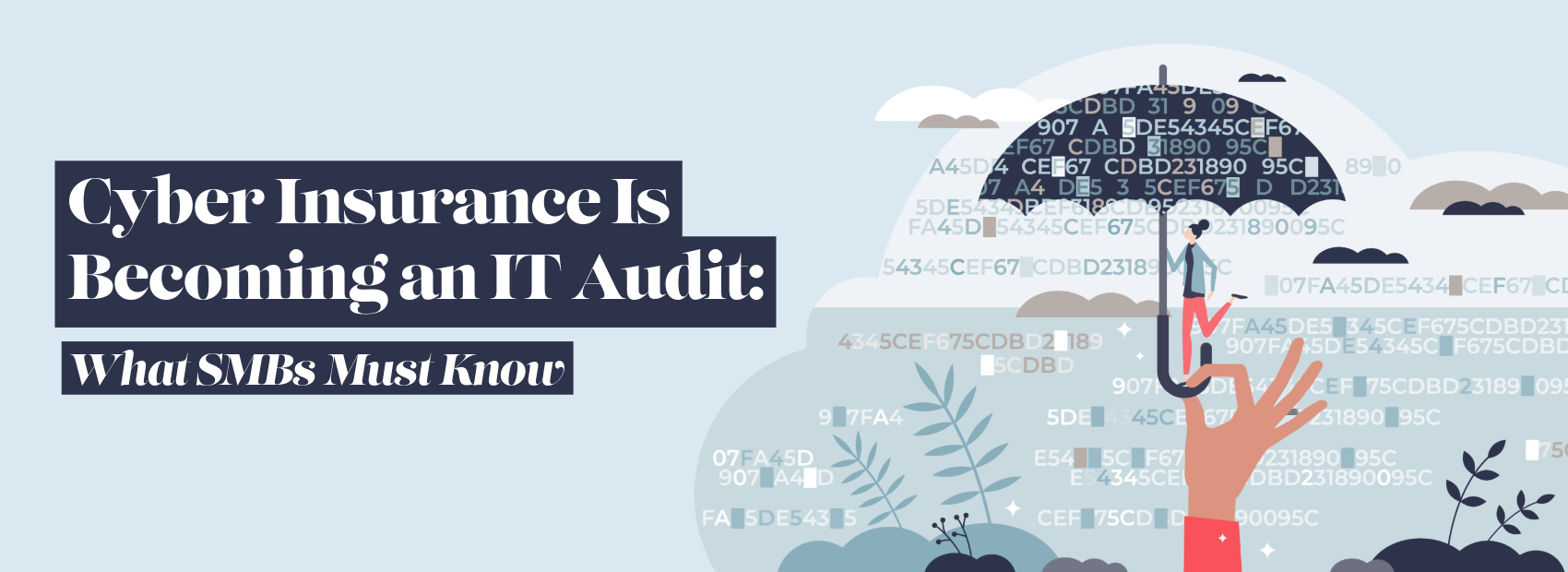
Cyber Insurance Requirements are changing rapidly for small and medium-sized businesses. What once felt like a simple insurance application has evolved into a deep review of an organization’s cybersecurity posture, operational maturity, compliance readiness, and risk management practices.
Insurance carriers no longer want simple yes-or-no answers about cybersecurity protections. Instead, they now require evidence that organizations actively maintain and monitor secure environments.
As a result, many SMBs are discovering that cyber insurance applications now resemble full IT and security audits.
Insurance providers increasingly evaluate:
- Multi-factor authentication (MFA)
- Endpoint protection
- Backup strategies
- Incident response plans
- Security awareness training
- Email protection
- Vulnerability management
- Compliance controls
- Business continuity planning
Unfortunately, organizations with weak cybersecurity controls may now experience:
- Coverage denials
- Higher premiums
- Reduced coverage limits
- Larger deductibles
- Exclusions for ransomware events
Consequently, SMBs must begin treating cyber insurance preparation as part of their overall cybersecurity strategy rather than simply a yearly renewal process.
The Cybersecurity and Infrastructure Security Agency (CISA) recommends organizations align cybersecurity controls and risk management practices with evolving cyber insurance expectations to improve resilience and reduce exposure.
Why Cyber Insurance Requirements Are Increasing
Cyberattacks continue to grow in frequency, sophistication, and financial impact. As a result, insurance carriers have experienced substantial losses related to:
- Ransomware
- Business email compromise
- Data breaches
- Operational downtime
- Supply chain attacks
- Social engineering fraud
Unfortunately, many businesses previously obtained cyber insurance without implementing even basic cybersecurity protections.
As claims increased, insurers began tightening underwriting standards.
Today, carriers want proof that businesses actively reduce risk rather than relying solely on insurance after an incident occurs.
Consequently, SMBs should expect more detailed security questionnaires and technical validation requests during renewals.
Multi-Factor Authentication Is Now Mandatory
One of the most common Cyber Insurance Requirements involves multi-factor authentication.
Many carriers now require MFA across:
- Email systems
- VPN access
- Administrative accounts
- Remote access platforms
- Cloud applications
- Microsoft 365 environments
Organizations lacking MFA protection may:
- Fail underwriting reviews
- Receive limited ransomware coverage
- Pay significantly higher premiums
Unfortunately, many SMBs still maintain:
- Shared credentials
- Weak passwords
- Unprotected remote access
- Inconsistent MFA enforcement
As a result, businesses become high-risk applicants in the eyes of insurers.
Microsoft recommends organizations implement multi-factor authentication broadly because compromised passwords remain one of the leading causes of account breaches and ransomware attacks.
Endpoint Protection Is Under Heavy Review
Cyber insurers increasingly evaluate the maturity of endpoint security protections.
Traditional antivirus software alone is often no longer sufficient.
Many carriers now expect:
- Endpoint Detection and Response (EDR)
- Managed Detection and Response (MDR)
- Real-time monitoring
- Threat hunting
- Behavioral analysis
- Automated isolation capabilities
Unfortunately, some SMBs still operate with outdated endpoint protection strategies.
As a result, insurers may view those businesses as more vulnerable to ransomware and operational disruption.
Additionally, insurers may request evidence showing:
- Security monitoring processes
- Alert response procedures
- Patch management practices
- Device inventory controls
Consequently, cybersecurity maturity now directly affects insurability.
Backups Are No Longer Enough
For years, businesses believed backups alone were sufficient protection against ransomware. However, insurers now understand that not all backup systems are equal.
Many cyber insurance applications now ask:
- Are backups immutable?
- Are backups encrypted?
- Are backups tested regularly?
- How quickly can systems recover?
- Are backups separated from production environments?
Unfortunately, many SMBs rarely test restorations until an emergency occurs.
As a result, organizations sometimes discover corrupt or incomplete backups during a real incident.
Consequently, insurers increasingly expect businesses to maintain documented business continuity and disaster recovery procedures.
The NIST Cybersecurity Framework recommends organizations regularly test recovery procedures, validate backups, and maintain operational resilience plans to reduce business disruption during cyber incidents.
Security Awareness Training Is Becoming Essential
Human error remains one of the largest causes of cybersecurity incidents.
As a result, insurers increasingly require businesses to implement:
- Phishing simulations
- Security awareness training
- Employee education programs
- Acceptable use policies
- Incident reporting procedures
Unfortunately, AI-powered phishing attacks are becoming far more convincing.
Employees now face:
- Voice cloning scams
- AI-generated phishing emails
- Executive impersonation attacks
- Fake vendor communications
- Deepfake social engineering attempts
Consequently, businesses that fail to train employees properly may experience increased operational and financial exposure.
Cyber Insurance Applications Are Becoming Technical
Many SMB owners are surprised by how technical cyber insurance applications have become.
Applications now commonly ask:
- Is MFA enabled everywhere?
- Are privileged accounts monitored?
- Is endpoint detection deployed?
- How often are vulnerabilities scanned?
- Are systems patched regularly?
- Are backups tested?
- Are incident response plans documented?
Some insurers even conduct:
- External vulnerability scans
- Security posture reviews
- Email configuration checks
- Dark web exposure analysis
As a result, businesses must often involve IT providers, security consultants, or compliance specialists during the insurance renewal process.
Compliance and Cyber Insurance Are Converging
Many cyber insurance carriers now align underwriting requirements with compliance standards involving:
- HIPAA
- PCI-DSS
- SOC 2
- CMMC
- FTC Safeguards Rule
Consequently, organizations with mature compliance programs often perform better during underwriting reviews.
However, businesses lacking documentation and governance may struggle to demonstrate operational maturity.
This creates additional pressure for SMBs to improve:
- Documentation
- Policy management
- Security governance
- Vendor oversight
- Risk assessments
As a result, cybersecurity and compliance discussions are becoming deeply connected.
The FTC Safeguards Rule requires many businesses handling financial information to maintain administrative, technical, and physical safeguards designed to protect customer data and reduce operational risk.
SMBs Must Prepare Before Renewal Time
One of the biggest mistakes SMBs make is waiting until policy renewal time to address cybersecurity concerns.
Unfortunately, remediation projects often require:
- Budget planning
- Technology deployment
- Policy development
- Employee training
- Documentation improvements
As a result, organizations may not have enough time to meet underwriting requirements before renewal deadlines.
Instead, businesses should continuously improve:
- Security controls
- Governance policies
- Backup strategies
- Monitoring capabilities
- User training
- Incident response readiness
Consequently, cyber insurance preparation should become an ongoing operational strategy.
How SMBs Can Improve Cyber Insurance Readiness
Organizations should proactively prepare for evolving Cyber Insurance Requirements rather than reacting under pressure.
Conduct a Cybersecurity Assessment
Businesses should evaluate:
- MFA coverage
- Endpoint security
- Backup maturity
- Email security
- Vulnerability exposure
- Access controls
Review Incident Response Plans
Organizations should document:
- Escalation procedures
- Recovery processes
- Vendor contacts
- Legal response workflows
- Communication strategies
Improve Documentation
Insurers increasingly want evidence involving:
- Policies
- Security standards
- Risk assessments
- Training records
- Backup testing
- Compliance activities
Train Employees Regularly
Security awareness training should address:
- Phishing
- AI scams
- Password security
- Social engineering
- Data handling procedures
Work With Trusted Advisors
SMBs often benefit from working with:
- Managed security providers
- Compliance consultants
- Cybersecurity specialists
- Insurance advisors
As a result, organizations gain stronger visibility into operational risk and insurance readiness.
Final Thoughts on Cyber Insurance Requirements
Cyber Insurance Requirements are no longer simple checklists. Today, they function much more like operational cybersecurity audits.
Insurance carriers want evidence that businesses actively reduce cyber risk rather than simply transferring financial liability through insurance policies.
Organizations that fail to improve cybersecurity maturity may face:
- Increased premiums
- Limited coverage
- Coverage exclusions
- Failed renewals
- Greater operational risk
Meanwhile, businesses that prioritize cybersecurity governance, compliance, and resilience will be in a stronger operational and financial position.
Most importantly, SMBs should recognize that cyber insurance is no longer separate from IT strategy. The two are now deeply connected.
Want to improve your cyber insurance readiness?
Start with:
- A cybersecurity assessment
- MFA validation
- Backup testing reviews
- Security awareness training
- Compliance gap analysis
- Incident response planning
The organizations preparing today will be far more resilient tomorrow.